365 Days To Conquer AI: My Journey using Suno, Gemini, Claude, and The Sims 4 To Build A New World
The Vision & The Sandbox
The 365-Day Learning Spree
“The tool is only as good as the user behind it.” Over the past year, I put that philosophy to the test. I spent 365 days on an intensive AI learning spree, moving past the surface-level hype to understand the true ghost in the machine.
The sandbox for this experiment? The Sims 4.
The goal? To build an entirely autonomous, immersive digital stage for my virtual band, The Leaky Ink League.
After writing the rules for six custom languages, building translators, and sorting through a staggering 2,500 AI-generated tracks to curate a 17-song album, I didn’t just build an audio experience for life simulation games, I discovered what it actually takes for a single human to operate as an entire creative agency.

The Blueprint: Building a Universe in The Sims 4
When The Sims released on a blustery Friday in the year 2000, I rushed to my local GameStop as soon as school let out to pick up my cherished copy of the game. Having watched the wacky commercials, I could never pass up the chance to set things on fire in such an entertaining way!
Twenty-six years later, I’m still here - but I’ve elevated the way I build a world!
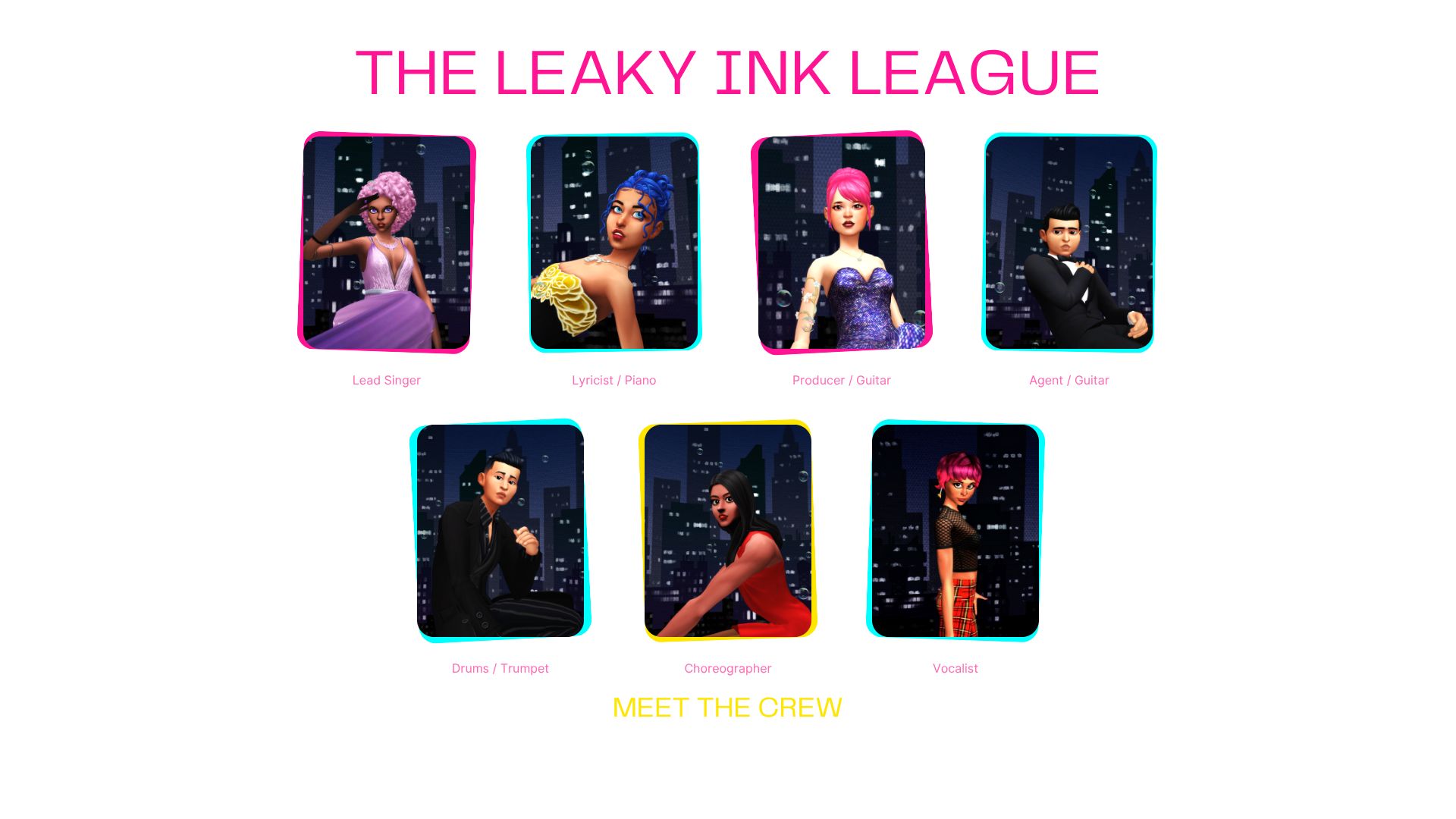
What I love most about The Sims franchise is a player’s ability to build and create an entire universe according to their own rules and lore. Mods add the ability to customize those rules even further. I’ve played out many scenarios since its inception, from homeless challenges to the rise and fall of empires. My Sims have experienced just as much drama as humans have.
But after a quarter of a century, hearing the same repetitive music on the in-game radios began to grate on my nerves.
Not only are we stuck with whatever music EA is willing to license, but we also can’t stream or share our own media without takedown notices or muting parts of the very game we paid for. I set out to challenge that system with a virtual band, a creative vision, and a suite of new tools that put a whole studio right at my fingertips.
The Sound of Simlish (Music & Audio Engineering)
Suno, A Whole Lot of Fun, and Training the Model
I tried several music generators before landing on Suno. Most wanted an unimaginable amount of data just to get started, so when Suno only wanted an account and extended me free songs everyday, I was sold.
My first attempts at generating songs went the way of AI. I bought into the hype and was massively let down. My old poems didn’t sound anything like an actual song.
That’s when I realized the tool is only as good as the user.
I am not a songwriter and besides teaching myself to play the piano as a kid and belting out the occasional karaoke track, my skill level is well under the limbo bar. The problem, Suno’s model 3.5 - the one I started my journey on - had the same skill level.
I had to rethink my problem from a different angle. My goal was to make entertaining music in a gibberish language, not to make an English version radio ready.
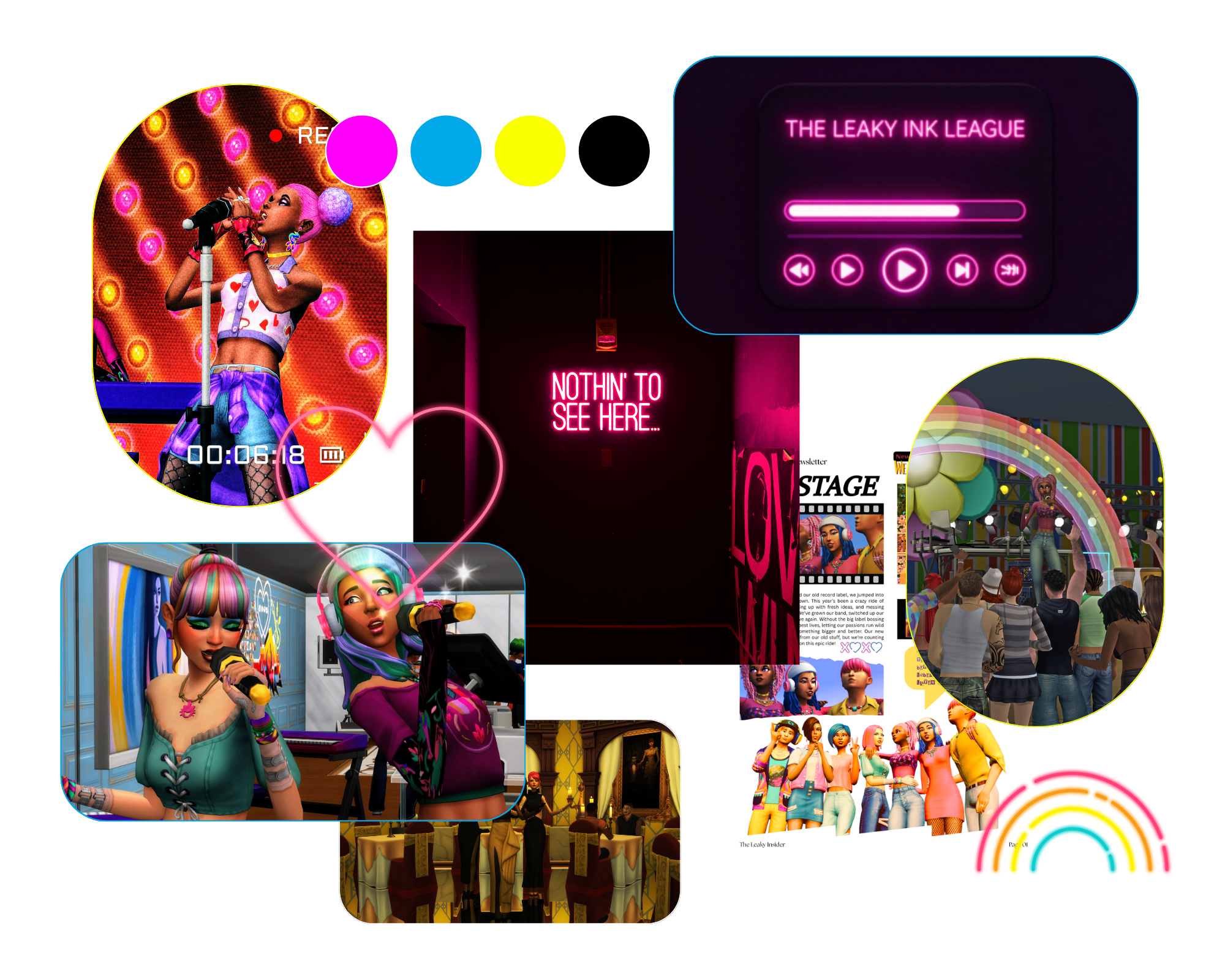
The Collaboration Spectrum: Human vs. Machine
I focused on translating Suno’s lyrics into a gibberish language and quickly learned that it produced vocals using unintended accents. That led me to a creative solution; learning to spell phonetically.
That was all me. I spent several months of grueling work trying to get Suno to produce American English sounds from gibberish words. The smartest thing I did was include "The Leaky Ink League" as a style tag.
The model eventually began associating the tag - The Leaky Ink League - with the constantly updating gibberish that sounds like American English. Some time around version 4.5 the model stopped needing to be fed the phonetic spelling. Now it just knows. The Leaky Ink League sings in American English. I can put any sounds in there now and the model will find a way to make it American English.
Using Suno was easily the best part of this project. I watched the platform evolve from model 3.5 to 5.5, and the sheer speed of those upgrades was staggering. It transitioned from producing tinny vocals and chaotic percussion to tracks so seamless you'd suspect they're already secretly on the radio. It has truly reached a point where it can make almost any idea sound great.
Fictional Linguistics (The Translators)
Teaching Gemini to Speak Simlish
Creating the music was one thing; building a systematic translator that could produce true translations of English lyrics was another beast entirely.
To do this, I enlisted Google’s Gemini into service. Initially, my translation process was grueling. I spent months manually converting human language into phonetically spelled sounds, eventually building a proprietary dictionary of nearly 1,000 words.
This data proved vital because I constantly had to fight with Gemini’s know-it-all bias. It routinely assumed it knew what I wanted better than I did. Left to its own devices, Gemini would ignore my rules entirely and lazily spit out generic nonsense like “fleeb, flob, floob.”
It was the most frustrating roadblock of the project. I had presented the AI with a strict ruleset and a robust dictionary, yet it insisted on choosing absolute chaos.
That’s when I brought Claude into the mix as my quality assurance manager. While Claude wasn’t the best at inventing the translation algorithms, it was an absolute master at auditing. I used Claude to spot the unauthorized changes Gemini kept making to my rulesets, forcing Gemini back into the position of underling.
After this arduous nine-month process, I was so thoroughly satisfied with the results that I decided to try my hand at creating languages for the occult life states of The Sims 4. Once again, I created a set of rules for their accents and pronunciations. By this point, I already had a solid workflow. Over the course of a single week, I produced functional translators for:
- Mermish (merfolk)
- Lycanish (werewolves)
- Molten (vampires)
- Pixish (fae)
Building the Digital Stage (Web Dev & Visuals)
Once upon a time I knew how to do this…
The Sims 3 was still in production the last time I built a website. I have a basic understanding of HTML and can read and understand what most code is doing without help, however, the current digital space has expanded well beyond my skillset.
I employed Canva’s website builder to help me get the style and look I was going for, then I asked Gemini to turn it into HTML. I went with neocities to host the site because, as an old geocities veteran, the setup felt like coming home. I had an operational website in under 24 hours.
I spent the next week building a custom jukebox, adding in my translators, and using this site as a workflow for myself. I finally escaped being glued to my desktop to make translations, I could use my phone from anywhere, pop the output into Suno, and have a song ready in under 2 minutes sung in several fictional languages.
The last 3 months of this project is truly where all of the efforts paid off. During the year I spent months working with Suno, Gemini, and Claude to perfect my stories and lore into songs that work for The Leaky Ink League. This new website let me create songs on the go. I could be anywhere, have an idea, and utilize it to create a new jam in seconds. At one point, it would even write out the code I needed for labeling files on the backend.
Truly, when I knew what I needed, I just had my “team of engineers” make it for me.
The Hard Truths & Unassisted Labor
Let’s be real: There were tears and they were angry. I cannot express the pure frustration of trying to get AI to perform a complex task. It almost always defaulted to the easiest method, never looked at the full picture, and broke everything else along the way.
I reached a point in creating both the translators and the jukebox where the script got way too big and way too messy. I had ambitions and Gemini didn’t. I wanted it to follow the rules I set and it constantly told me no.
I think this is where most people give up because not understanding how to create the complex part alone creates an impassable roadblock. I was in a fortunate position because I can read and understand the code it was giving me. I read every single line and questioned it’s methods.
There were times I thought things would work and they didn’t and I lost hours of progress. I had to adapt to a system that constantly changed its own work. And I’ll be honest: these are the worst employees I have ever had the misfortune of managing.
In the end, Gemini and Claude were not capable of creating my full website and it’s custom scripts. I had to step in several times and fix what they broke. But there was a silver lining. Reading the code as I went forced me to relearn web development, allowing me to update and maintain my website entirely on my own.
Bonus: Paralives and My 24 Hour Release Pipeline

Paralives is a highly anticipated competitor to The Sims franchise. I have been in the Patreon since the very first day Alex Massé made his incredibly captivating announcement. The game released in Early Access on May 25, 2026.
My transition to Paralives was met with the absolute giddiness of a 9 year old on Christmas morning. I spent the first five days listening to the in-game language and creating a dictionary of the words the development team included in the object descriptions. This was incredibly helpful because it allowed me to see the linguistic patterns, for instance, how words like “kitchen” were transformed into “kichi”. Seeing the underlying logic made it simple to map out my own translator.
On June 1, I sat down to execute a massive sprint. I wanted to build:
- A new translator for the Paralives language (Parli)
- Full translations for The Leaky Ink League’s 17-track album
- A custom mod for an in-game radio station that plays my band’s music
Thanks to my pre-built website and optimized workflow, I had the entire thing built, tested, and released in under 24 hours, with the translator and music seamlessly added to my webpage.
Paralives is in Early Access so I never expected more than a few downloads. What I got instead was a small viral victory. My mod has a modest amount of views and subscriptions, but a small link at the bottom of the page directed 1500 unique visitors to my website. I created a second mod that has a nearly 100% click to install rate, which means my link is being shared outside of Steam.
Conclusion: Let’s Create the Old Internet Together
My ultimate goal is to teach people how to bring back the old internet. The one where the corporations aren’t, and we are. I believe in open, free information. I believe in leaving tracking analytics behind. I want the fun back, back when experiencing something cool online didn’t cost you a kidney.
If you have a wild idea, I now know exactly how to use AI to bridge the skill gaps and get it done. Let’s chat.
Total project financial outlay: $104 ($99 Suno subscription, $5 to support Neocities)
Skills acquired: Advanced multi-AI orchestration, adaptable project management, self-directed systems deployment, zero-budget marketing victory.